SWIMMING SWIMMING
- HOME
- Swimming Safety Information
- Precautions When Playing in the Ocean
Precautions When Playing in the Ocean
Unlike a swimming pool, the ocean has waves and currents. Even strong swimmers can drown.
Before going to the beach, check whether the beach is officially open, assess your physical condition, and carefully check the weather forecast and what you need to bring.
- 1. What to Bring to the Beach
- 2. First, Understand the Ocean
- 3. When, Where, and With Whom to Swim
- 4. Dangerous Marine Life in the Sea
- 5. Do Not Swim After Drinking Alcohol
- 6. Never Leave Children Unattended
- 7. Listen to Your Body and Respect Your Limits
1. What to Bring to the Beach
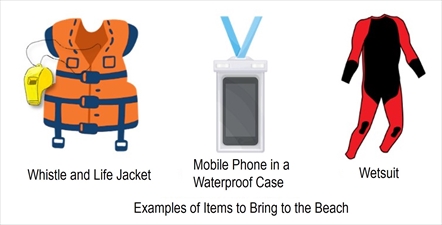
- When you go to the beach, bring a lifejacket or other buoyant aid, a whistle, and a mobile phone in a waterproof case to secure a means of communication.*
- When wearing a lifejacket or other buoyant aid, choose a type suitable for the intended use and area, make sure it fits your body, check for any damage, and wear it correctly.
Read the user manual and maintain your equipment properly. - The following items are recommended as basic equipment for safe swimming at the beach:
- Wetsuits and marine shoes help prevent injuries on coral reefs and rocky areas and provide protection from dangerous marine life. Wetsuits also help prevent loss of body heat.
- Rash guards and surf hats are effective for sun protection. Rash guards with neoprene also help keep you warm.
- To prevent heatstroke, bring drinking water or sports drinks and take frequent water and salt intake.
- Do not forget a smartphone or mobile phone to call for help in an emergency.
Buoyant aids here refer to items that fit closely to the body and do not come off easily, such as wetsuits (excluding float toys like inflatable rings).
2. First, Understand the Ocean
Buoyancy
- A person will generally float if their lungs are filled with air and sink if they are not.With the lungs filled, up to about 5% of the body (about 2% in freshwater) can stay above the surface.
However, in the sea or a river, waves and currents may prevent you from keeping your face above water, making breathing difficult. This is why extra caution is necessary.
Weather, Tides, and Other Conditions
- Check the weather and tide conditions in advance before going to the sea.If the weather worsens while you are in the water, strong winds, lightning, and high waves can create dangerous conditions. Some areas that are passable at low tide may become cut off at high tide, making it impossible to walk back.
- For tide predictions, refer to the tide forecast page provided by the Hydrographic and Oceanographic Department of the Japan Coast Guard ( external link).(Japanese Only)
Accident Example Related to Tidal Change
A person crossed to rocks during low tide to sunbathe and swim. When the tide rose, they realized they could no longer return by themselves and called 118 for rescue.
Wind
- Winds along the coast are generally classified as offshore and onshore. Offshore winds blow from land toward the sea; onshore winds blow from the sea toward the land.During the daytime, winds are often onshore, but depending on pressure patterns and local topography, strong offshore winds can also occur.Strong offshore winds can carry float toys and even swimmers far offshore, making it difficult to return to shore.Floating objects are more affected by wind than many people expect and can drift away quickly if you are not paying attention.
Accident Example Related to Strong Wind
An elementary school child was playing with an inflatable ring about 2 meters from the shoreline. When the father briefly looked away, the child quickly drifted about 10 meters offshore. The father swam after the child but could not catch up due to the speed of the drift. The child was eventually rescued by a rescue boat about 100 meters offshore.
Waves and Sea State
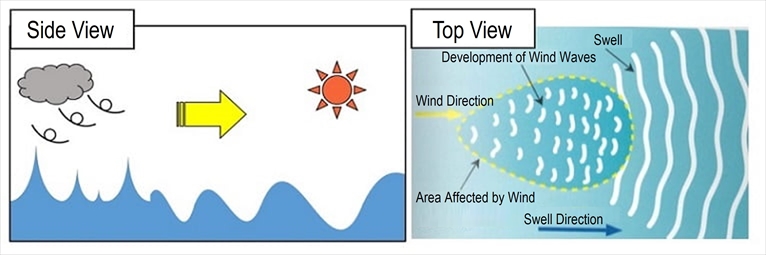
- Sea waves are broadly divided into two types: “wind waves,” generated by local winds, and “swell,” which are waves that have traveled from distant weather systems or remain after the wind has weakened or changed direction. Together, these are referred to as the sea state.
- Significant Wave Height
In weather forecasts by the Japan Meteorological Agency, the “wave height” usually refers to the significant wave height. When the sea state is steady, about 1 out of 100 waves may be 1.5 times higher than the significant wave height, and about 1 out of 1,000 waves may be nearly twice as high.So even if the forecast says 1-meter waves, there is still a possibility that some waves could approach 2 meters in height. - Waves That Require Special Caution
- “One big wave”: a very large wave formed when several waves overlap and concentrate in one place (sometimes called a freak or rogue wave).
- “Doyou-nami”: long-period swell generated by distant typhoons thousands of kilometers to the south, which can reach the Pacific coast of Japan.
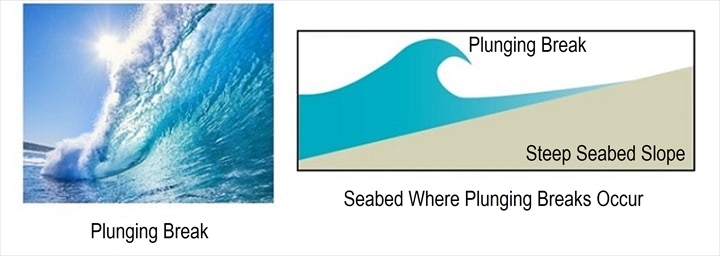
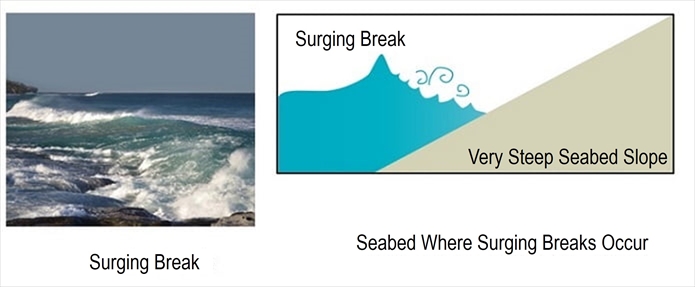
- Plunging and surging breakers: explained later in "3. When, Where, and With Whom to Swim."
Rip Currents
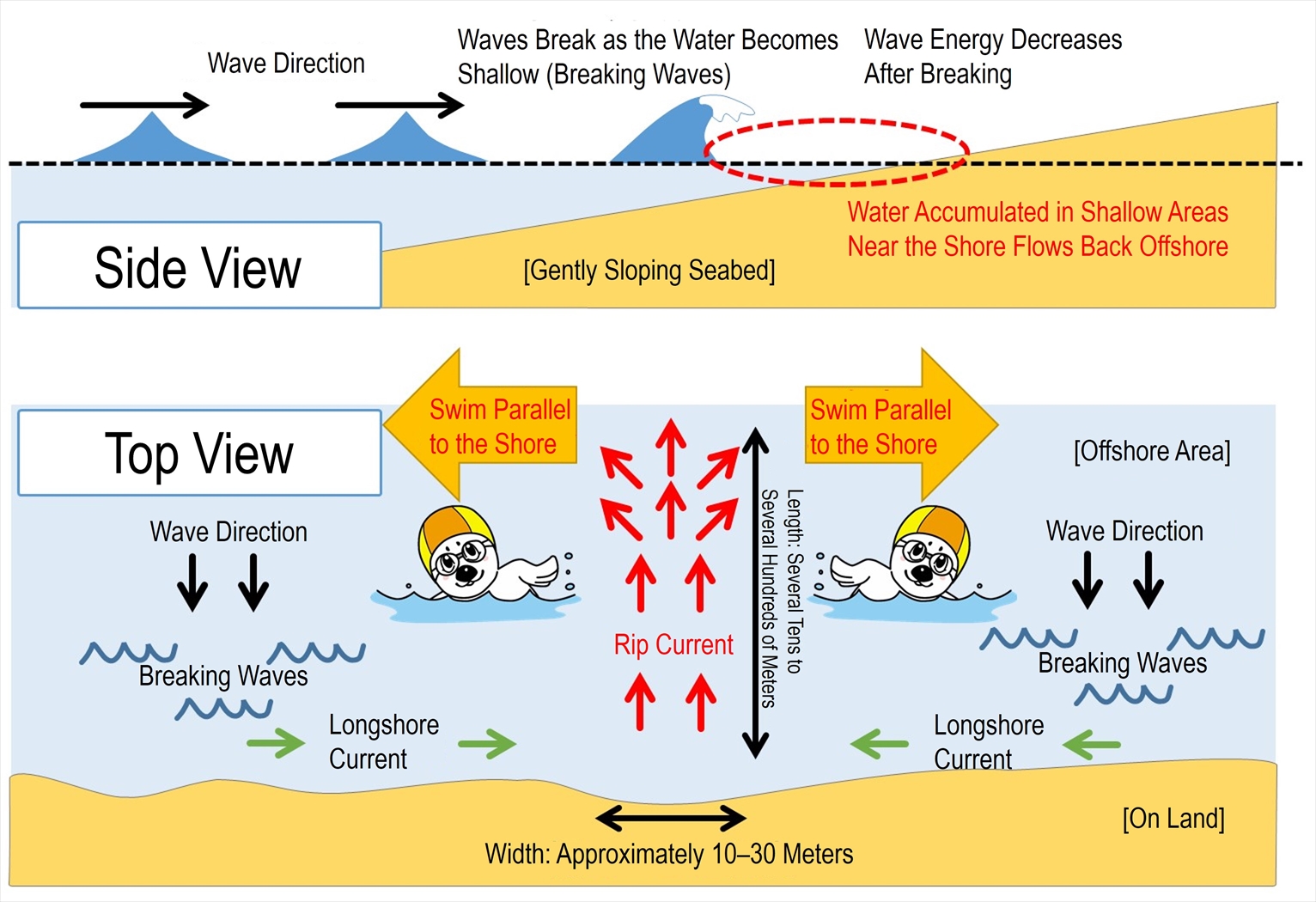
- Be especially aware of strong currents flowing offshore, known as rip currents.Rip currents can be extremely strong. Once caught in one, you may be carried far offshore without realizing it. Even Olympic-level swimmers find it difficult to swim directly against them.
- Rip currents are typically narrow, about 10–30 meters wide. If you are carried offshore, stay calm and swim parallel to the shoreline to get out of the current.If you cannot swim out, adopt a relaxed floating position and wait for rescue.
Examples of floating techniques are shown in “What to Do When You Feel in Danger – 3. How to Float.”
Return Flow (Backwash Currents)
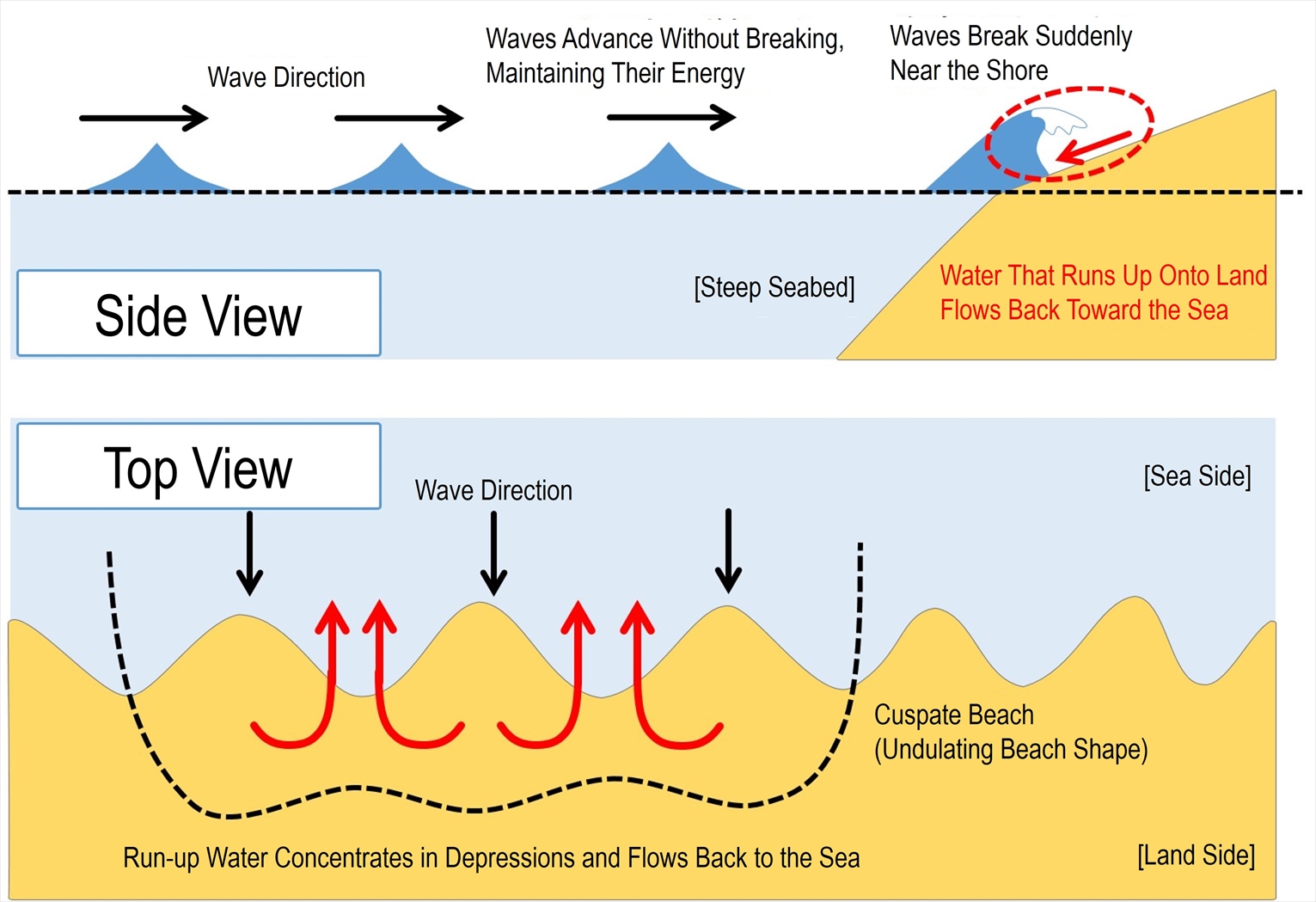
- On shorelines with irregular shapes called cuspate beaches, strong backwash currents can form as waves that have run up the beach return to the sea. When the waves are high, stay away from the water’s edge.
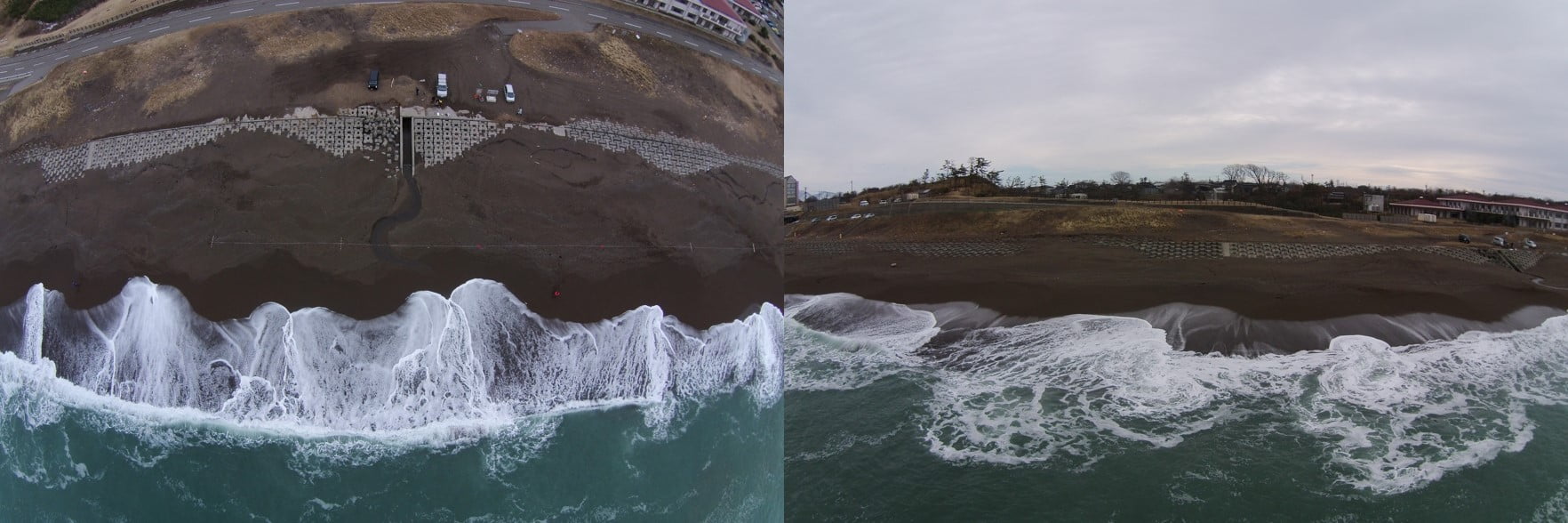
Topography and Changing Waves and Currents
- In the sea, there may be sudden drop-offs and areas where currents become faster due to tidal changes. To avoid panic when you suddenly cannot stand or cannot return, know the shape and depth of the area where you are swimming. Waves and currents are constantly changing. Keep observing the sea conditions around you.
Reference: In the Case of Rivers
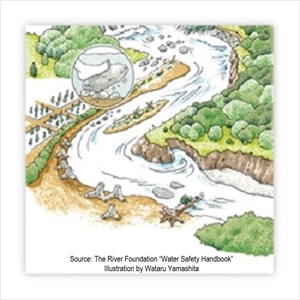 ●Natural rivers vary from upstream to downstream, and each river has its own characteristics. Deep sections and fast currents are common. Even with water only up to your knees, a strong current can sweep away an adult.
If you are swept away, you must not only keep your airway above water but also use swimming or other movements to escape the current and reduce the force acting on your body.
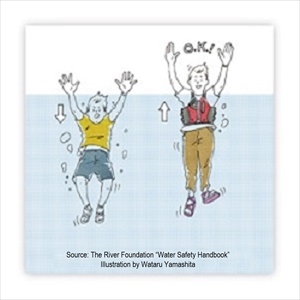 ●There is always a risk of drowning in water. In flowing water, hydraulic phenomena can push you toward the riverbed or hold you under water.Natural buoyancy alone is not enough to counter these forces. To reduce the risk as much as possible, wearing a lifejacket and having the right knowledge and skills to avoid hazards are essential.
Image provided by: River Foundation, Children’s Waterside Support Center
3. When, Where, and With Whom to Swim
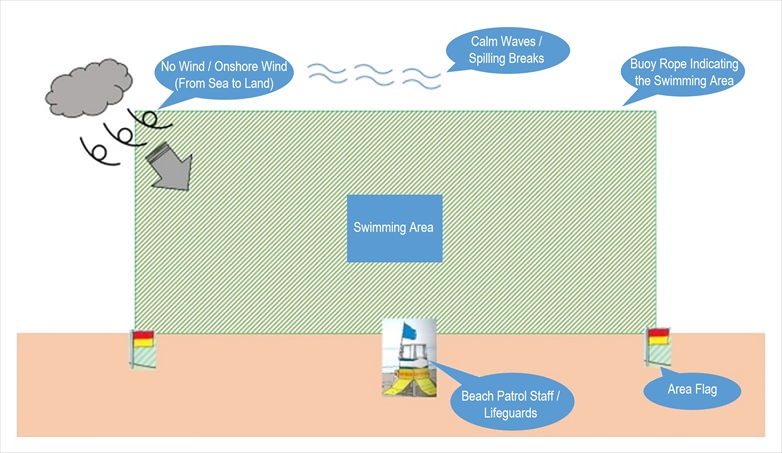
- In the sea, always swim at managed or supervised beaches. In natural environments such as seas and rivers, self-rescue—protecting your own life—is fundamental.
What Is a Managed / Supervised Beach?
- Lifeguards or safety patrol staff are on duty.
- Buoy lines mark the designated swimming area.
- Flags are used to show the swimming area.
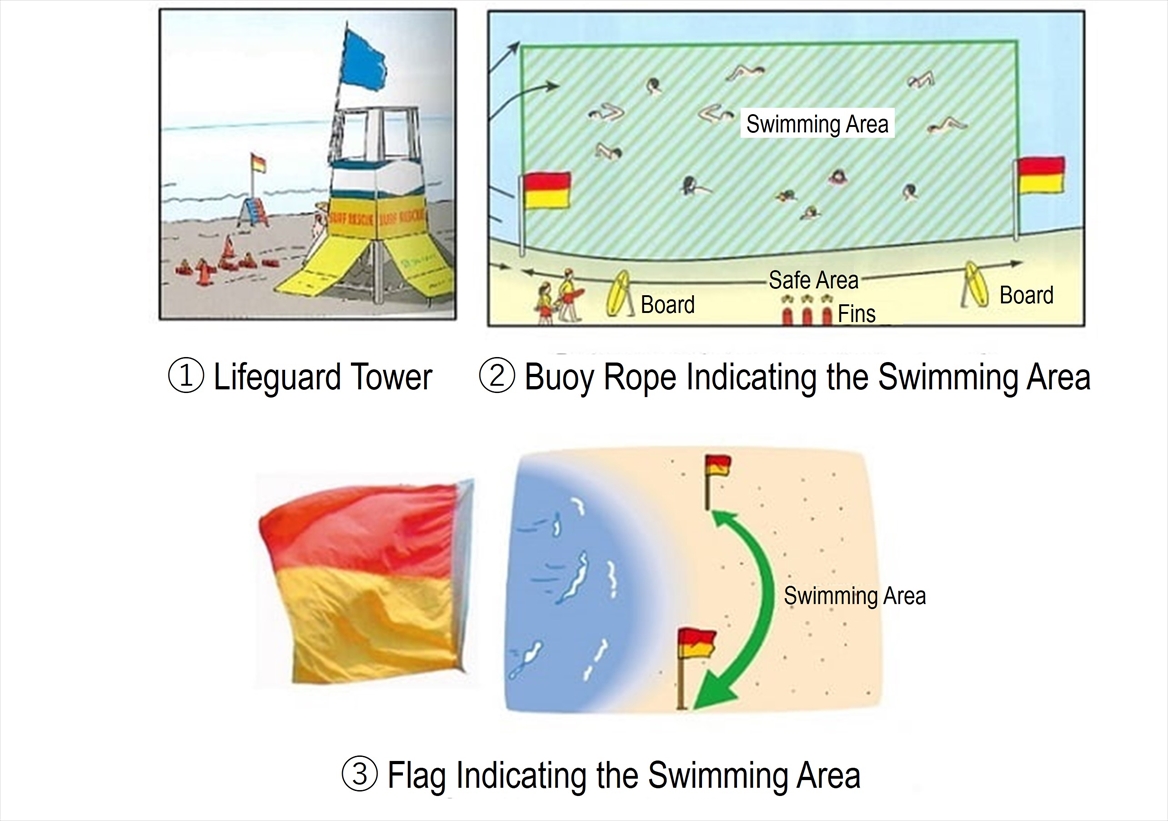
Suitable Natural Conditions for Swimming
- It is also important to swim only under suitable natural conditions.
- Calm waves are best.
Gentle breaking waves on gently sloping sandy beaches are relatively suitable.
- Little or no wind, or light onshore winds (from sea to land).
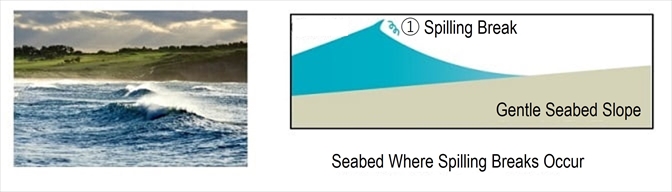
①Example 1: Calm breaking waves
- Calm waves are best.
Locations That Are Especially Dangerous
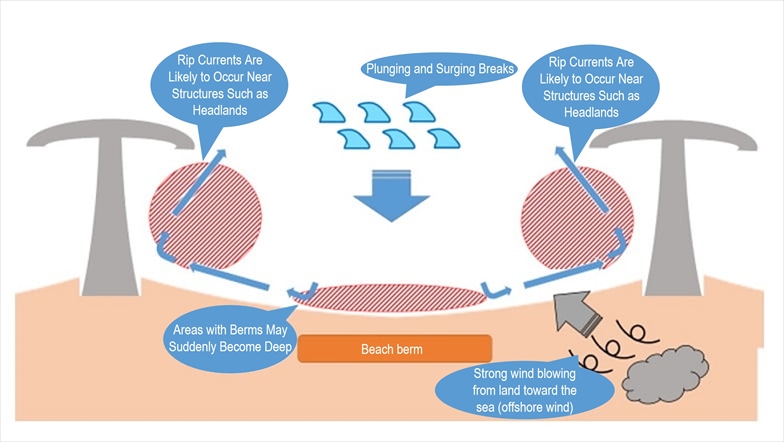
- The following areas may have sudden drop-offs or complex strong currents and are extremely dangerous:
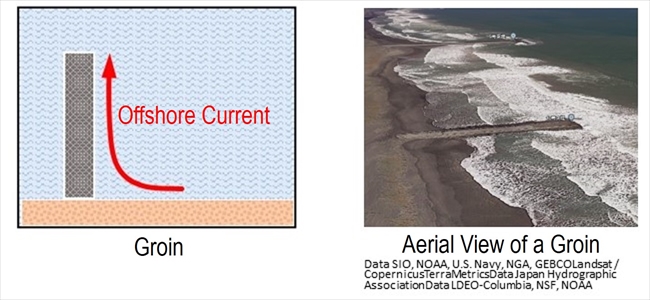
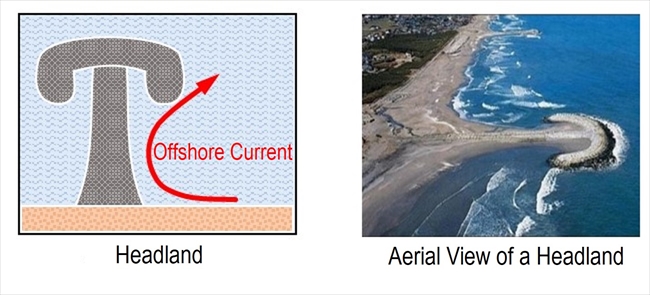
- Near structures such as groynes and headlands
- Areas with sand berms
①Near structures such as groynes and headlands
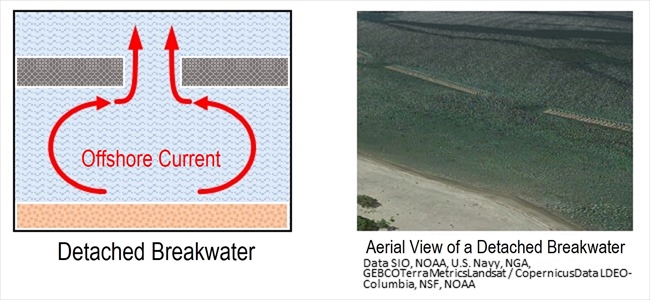
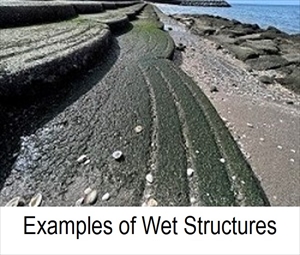 Around groynes and headlands, which are artificial structures built to prevent sand loss, rip currents and other complex flows are likely to form. Do not swim near these structures.
These structures become very slippery when wet, and you may fall into the sea. Do not play on them. If you fall in, climbing back onto the structure is extremely difficult.
②Areas with Berms
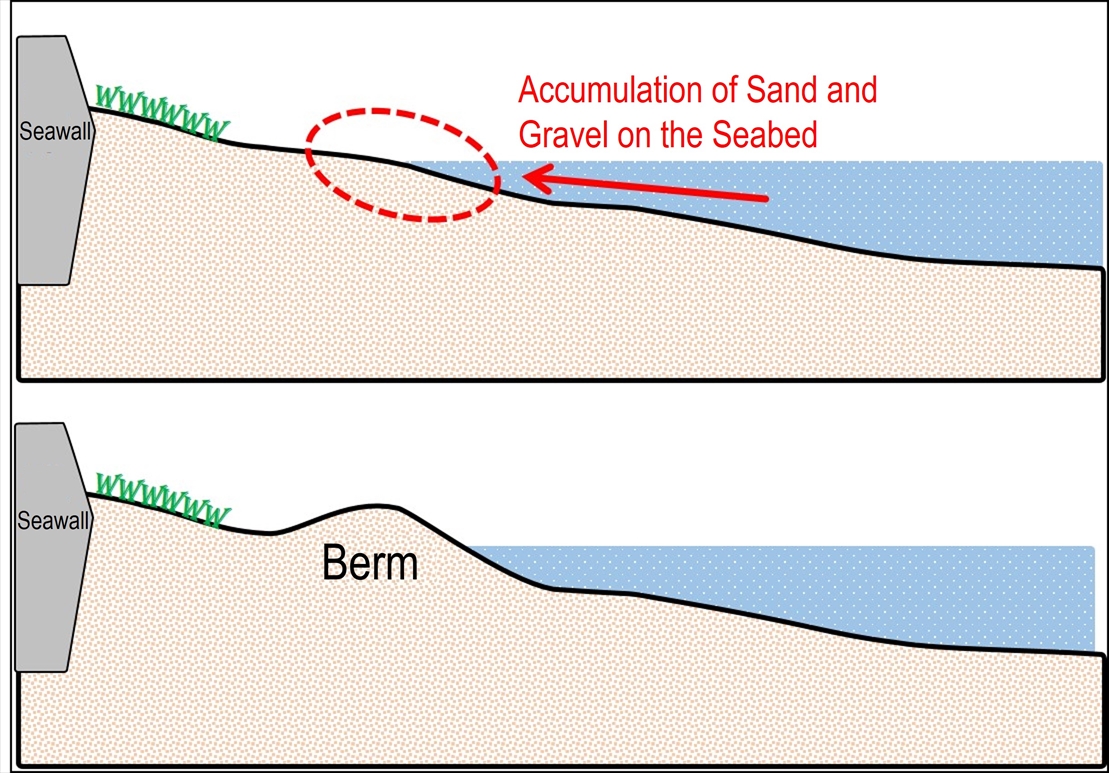
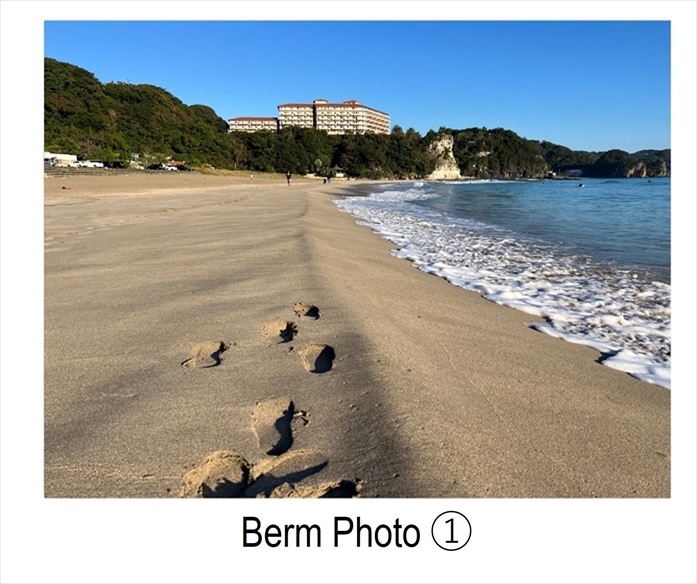
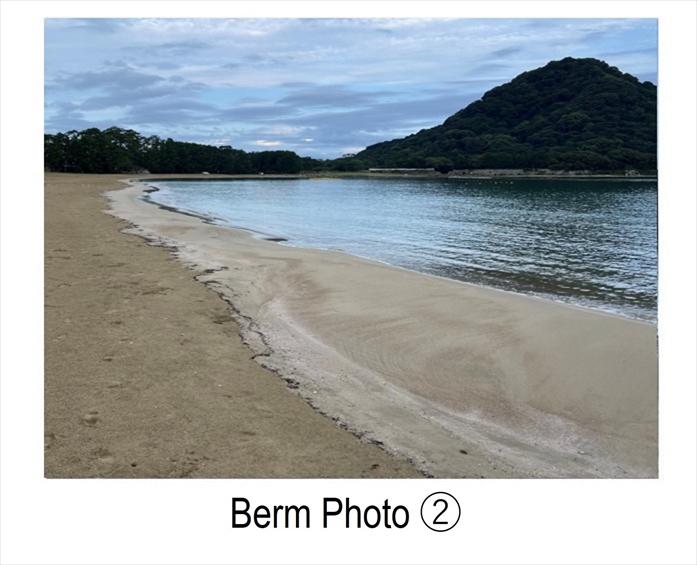
Wave action can form low ridges of sand along the shoreline, called berms.
Because sand and gravel are piled up to form berms, there may be sudden deep spots near them. This requires special caution.
At such locations, the sand at the water’s edge feels soft and your feet may sink. The waves often break in a single line with a strong crashing motion.
Natural Conditions Unsuitable for Swimming
- It is dangerous to swim under the following conditions:
- When plunging or surging breakers (powerful breaking waves) are present
- Wind speeds of up to about 6 m/s are generally acceptable, but even at around 2 m/s, an offshore wind can push float toys so fast that you cannot catch them.
- (Based on MLIT Ports and Harbours Bureau / Japan Marina & Beach Association “Beach Planning and Design Manual 2005”)
①Plunging and Surging Breakers
Example of a Beach Suitable for Swimming
Example of a Beach Unsuitable for Swimming
- Swimming outside the designated swimming area may lead to collisions with personal watercraft or pleasure boats, causing serious accidents. Always stay within the marked swimming zone.
Accident Example: Collision Between Swimmer and Personal Watercraft
A man was swimming 10–15 meters offshore when he was struck by a passing personal watercraft. He suffered a head laceration and was transported to the hospital.
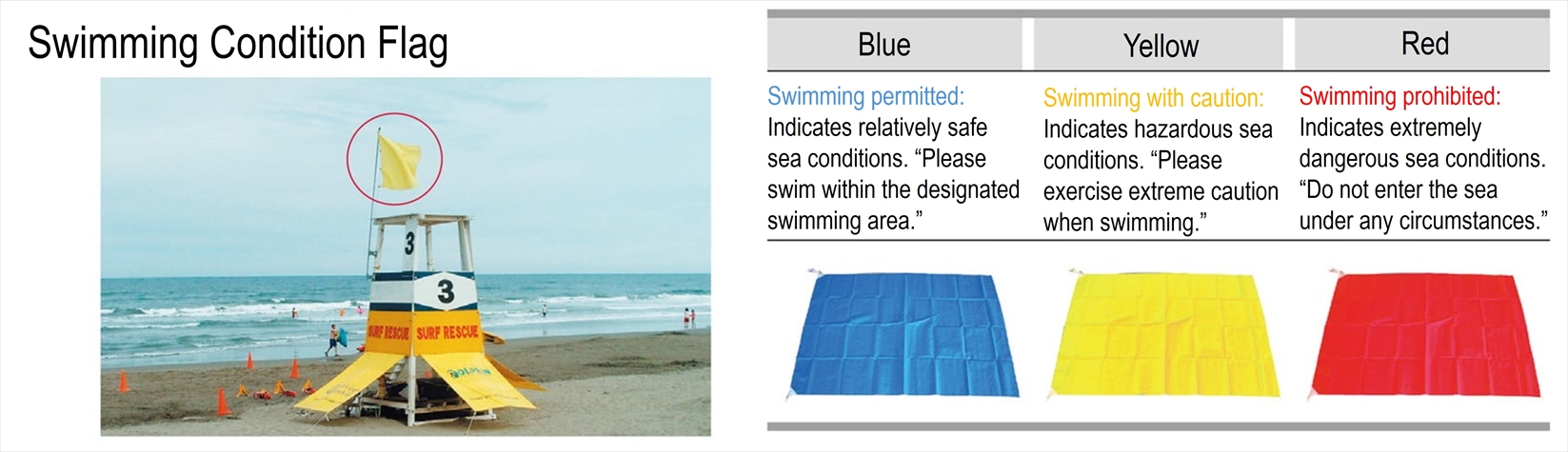
- Even at managed beaches, do not enter the water if swimming is prohibited due to bad weather or other reasons.Follow the instructions of the beach management and the colored flags (blue, yellow, red) indicating swimming conditions on that day.
- If a tsunami is expected, information is communicated by municipal emergency broadcasts, beach managers, and lifeguards. At some locations, a tsunami flag may be raised to indicate an emergency.Follow tsunami evacuation signs, remain calm, and evacuate quickly along the designated routes.
Example of Markers Used When a Tsunami Is Expected
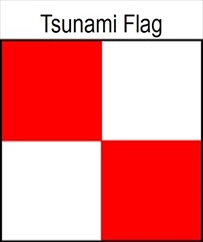
The Japan Meteorological Agency prescribes a red-and-white checkered flag as a visual signal for tsunami advisories and warnings.
For details, see the Japan Meteorological Agency website (external link).(Japanese Only)
Example of Signs Related to Tsunami Evacuation
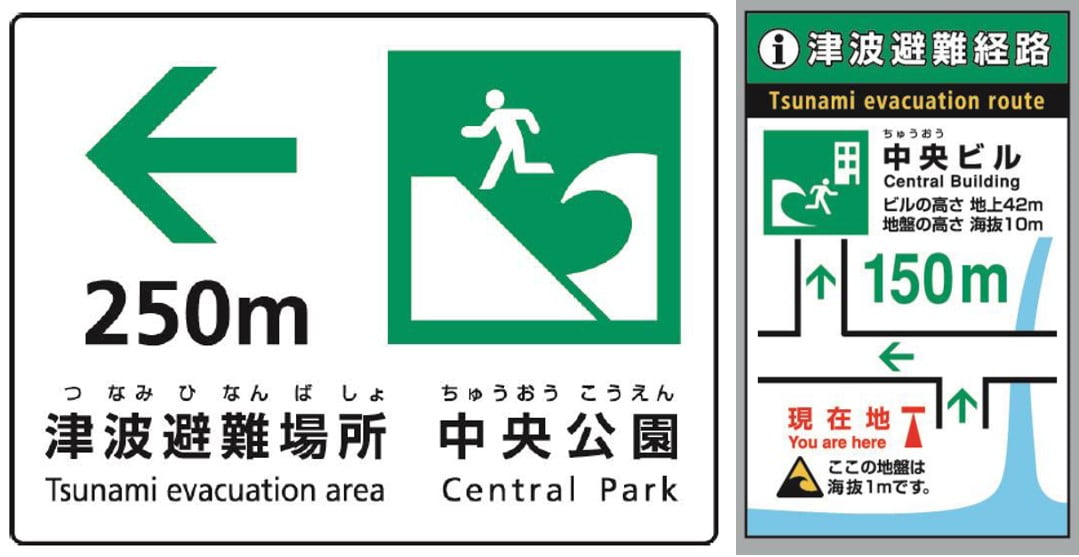
Example of tsunami evacuation signs
(from materials by the Nippon Signs Association).
Reference: In the Case of Rivers
Swimming in rivers is generally allowed, but some areas are prohibited by local governments. Always check local information and choose safe, permitted locations.For more on safe play areas in rivers, see the “Waterfront Safety Handbook” by the River Foundation, Children’s Waterside Support Center (external link).
Go with Others, Not Alone
- Swimming with family or friends makes it easier for others to notice if something goes wrong.
※However, some accidents occur when someone in a group later acts alone. Stay alert and avoid separating from others. - If you swim alone, you may not be able to call for help, and rescue may be delayed.
If you must go alone, never push yourself. - Tell family or friends where you will be and when you expect to return, and keep in regular contact.
4. Dangerous Marine Life in the Sea
The sea is home to many dangerous marine creatures, such as jellyfish and rays.If you are stung or injured by such creatures, leave the water immediately and seek medical attention at a hospital or clinic.
For an example of first-aid measures, see the Japan Lifesaving Association’s information “What to Do If You Are Stung by Jellyfish”(external link).(Japanese Only)
Examples of Dangerous Marine Life
- Coastal waters: jellyfish, Portuguese man-of-war, sharks, etc.
- Rocky areas and coral reefs: blue-ringed octopus, long-spined sea urchins, lionfish, moray eels, sea anemones, crown-of-thorns starfish, trumpet sea urchins, cone snails including Conus geographus, and corals.
- Sandy bottoms: bristle worms, rays, stonefish, etc.
- Rocky reefs and near breakwaters: striped catfish (gonzui), etc.
- Open water: sea snakes, etc.
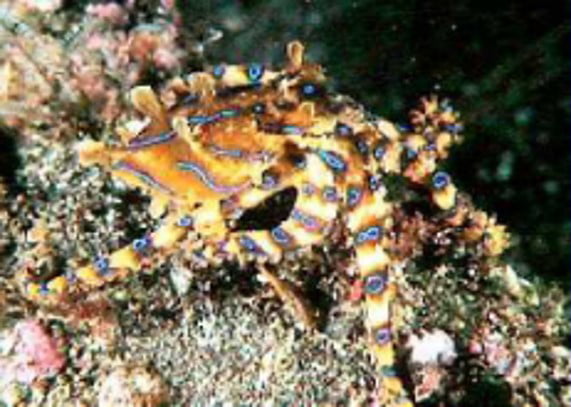
Blue-ringed octopus
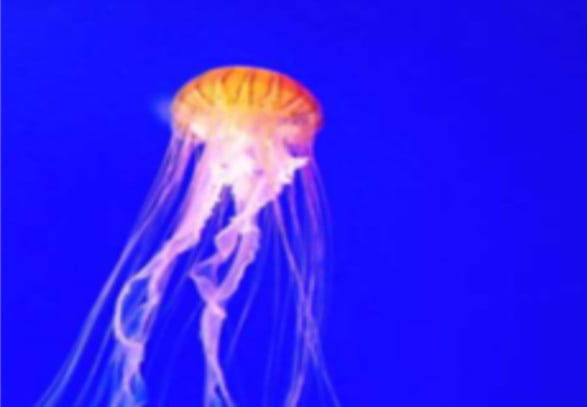
Jellyfish
- The distribution of dangerous marine life varies by region and season. Check information from local prefectures and municipalities. For example, Okinawa Prefecture provides information under “Beware of Dangerous Sea Creatures” on its website.
5. Do Not Swim After Drinking Alcohol
- Alcohol impairs judgment, concentration, and physical coordination, reducing your swimming ability and increasing the risk of drowning.
- Entering the sea after drinking greatly increases both the chance of drowning and the likelihood of death if you do drown. Never go into the water after drinking.
- Look out for each other. If someone in your group tries to swim after drinking, stop them.
- For more information, see the Japan Lifesaving Association’s “If You Drink, Don’t Swim” campaign (external link).(Japanese Only)
6. Never Leave Children Unattended
- Children cannot judge danger as well as adults.Even small unexpected waves can knock them over and cause drowning. Parents and guardians must stay close to children at all times and have them wear lifejackets whenever possible.
- If you see a child alone near the water, an adult should immediately pay attention and ensure their safety.
- Accidents where children are swept offshore from the water’s edge have occurred. Even if they are only near the shoreline, never let your guard down.
- When entering the water, adults should go first, and when leaving, adults should come out last.
- Adults should stay on the offshore (deeper) side of the children while playing in the sea.
- If float toys or sandals drift away, make sure children do not chase after them.
Accident Example: Child Left Unattended
A lower-grade elementary school child was swimming at the beach with their family. Waves began to reach the tent set up near the shoreline.While the guardians were busy moving the tent and had taken their eyes off the children, the older sibling reported that the younger brother was drowning.The child was rescued by a guardian and resumed spontaneous breathing but was hospitalized unconscious. The child was not wearing a lifejacket.
- For more information, see the Children and Families Agency’s “Child Accident Prevention Handbook” (external link).(Japanese Only)
7. Listen to Your Body and Respect Your Limits
- Be honest about your physical condition. If you feel tired or sleep-deprived, do not go into the sea.
- Always warm up before entering the water.
- If you feel cold or cannot stop shivering, these may be early signs of hypothermia.Hypothermia can be life-threatening, so get out of the water immediately and:
- Remove wet clothing and dry your body.
- Change into dry clothes.
- Wrap yourself in a blanket.
- Drink something warm slowly.
- To prevent heatstroke, wear a hat, drink water and take salt frequently, and avoid staying under direct sunlight for long periods.