SWIMMING SWIMMING
- HOME
- Swimming Safety Information
- What to Do When You Feel in Danger
What to Do When You Feel in Danger
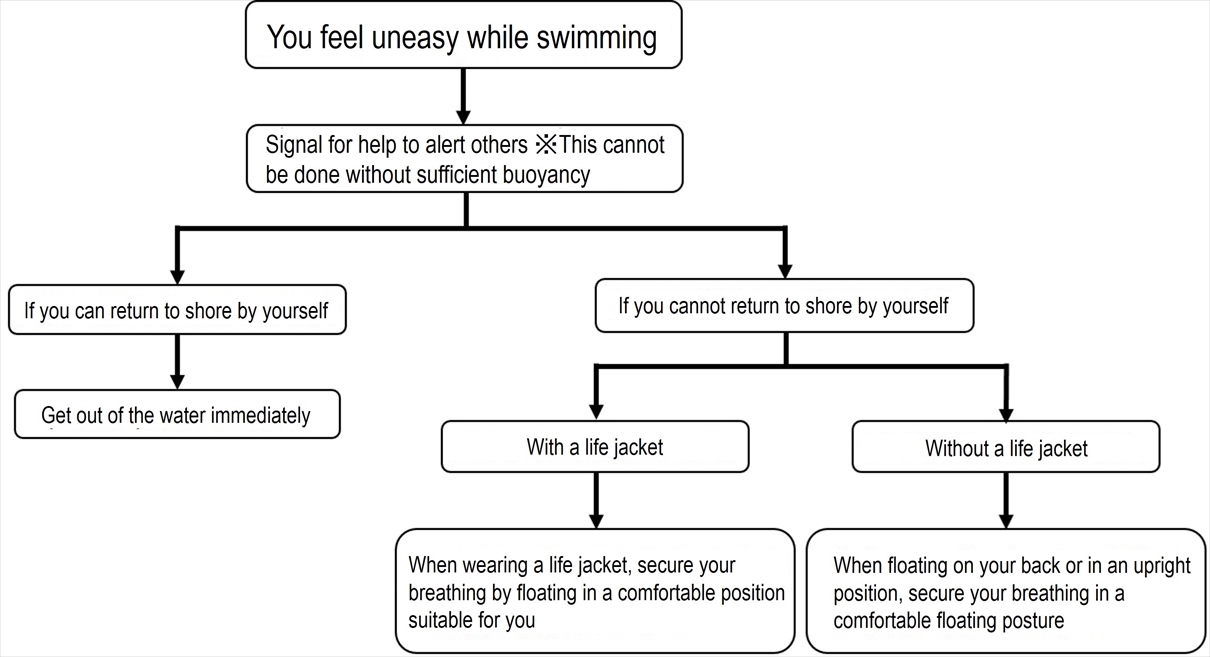
If you feel unsafe while swimming, use a “help signal” to alert people around you.
If you are able to swim back by yourself, stay calm, consider your physical strength, and head toward the nearest shore.
If it is difficult to reach land on your own, float in a relaxed position and wait for rescue.
- 1. Use a “Help Signal” to Alert Others
- 2. Learn Self-Rescue Skills
- 3. Examples of Floating Techniques
- In the sea, securing your breathing is the most important priority.
- To secure breathing, it is essential to secure buoyancy.
- In seawater, only about 5% of your body (about 2% in freshwater) naturally remains above the surface.
- Wear a lifejacket to ensure sufficient buoyancy.
1. Use a “Help Signal” to Alert Others
What Is a “Help Signal”?
- A “help signal” is a way to show that you are in trouble and need assistance from people around you (such as lifeguards or safety staff at the beach). It can also be used when you notice someone else in trouble or drowning and need to call for help.
- If you can stand or float, raise one arm and wave it widely from side to side. If you are wearing a lifejacket with a whistle, blowing the whistle is also very effective.
- If you are not wearing a lifejacket or other buoyant aid and are barely able to float, waving your arms vigorously may cause you to sink. This is another reason why wearing a lifejacket is important.
When to Use a “Help Signal”
- Use a help signal whenever you experience trouble or feel unsafe, for example:
- When you feel you are being swept away by a rip current or other strong flow
- When you have fallen from a breakwater or structure and cannot get back onto land
- When you get a cramp in your leg
- When you feel very cold or cannot stop shivering
- When you are stung by jellyfish or other marine creatures
2. Learn Self-Rescue Skills
Point
Wear a lifejacket.
Float in a relaxed position and wait for rescue.
●To prevent drowning, always wear a lifejacket in advance.
➤Choose a lifejacket that fits your size, fasten all belts securely, and check how to wear it correctly so it will not come off.
➤Children should wear lifejackets with crotch straps.
●There are various floating techniques. Learn and practice the ones that suit you in advance.
●By floating, you can keep breathing, calm yourself, observe your surroundings, and decide on your next action.
Why Is Self-Rescue Necessary?
- Mechanism of Drowning
The specific gravity of the human body changes depending on its condition. On average, it is about 0.98 when inhaling and about 1.03 when exhaling. This means that in freshwater, you float when your lungs are filled with air and sink when they are not.
The upper body is lighter due to the lungs, while the lower body is heavier due to muscle mass. As a result, even if you try to float horizontally with your body straight, your legs tend to sink.After a while, the body tends to tilt vertical. In state (a), when you have inhaled, about 98% of your body is underwater and only about 2% is above the surface.
In state (b), when a drowning person raises an arm to call for help, that small 2% above the surface is used by the arm, and the head and mouth sink further underwater.In state (c), when they shout “help,” air is expelled from the lungs, the body becomes heavier than water, and they sink even more.In other words, a drowning person “quietly sinking” is the result of being vertical in the water, raising an arm, and calling out for help—all of which reduce buoyancy and cause further sinking.
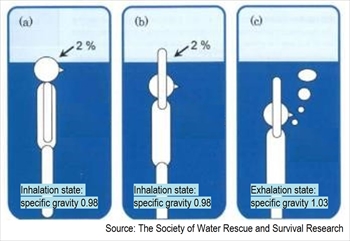 Even with air in the lungs, only about 2% of the body floats in freshwater (about 5% in seawater).
➤In seas and rivers, waves and currents can prevent you from keeping your face above the surface, making breathing difficult.
➤If you do not have enough buoyancy, trying to shout or wave for help may cause you to sink and drown.
➤Self-rescue techniques are essential to secure breathing.
- When you feel you are being swept away by a rip current or other strong flow
- When you have fallen from a breakwater or structure and cannot get back onto land
- When you get a cramp in your leg
- When you feel very cold or cannot stop shivering
- When you are stung by jellyfish or other marine creatures
Point
Float in a relaxed position and wait for rescue.
➤Choose a lifejacket that fits your size, fasten all belts securely, and check how to wear it correctly so it will not come off.
➤Children should wear lifejackets with crotch straps.
The specific gravity of the human body changes depending on its condition. On average, it is about 0.98 when inhaling and about 1.03 when exhaling. This means that in freshwater, you float when your lungs are filled with air and sink when they are not.
The upper body is lighter due to the lungs, while the lower body is heavier due to muscle mass. As a result, even if you try to float horizontally with your body straight, your legs tend to sink.After a while, the body tends to tilt vertical. In state (a), when you have inhaled, about 98% of your body is underwater and only about 2% is above the surface.
In state (b), when a drowning person raises an arm to call for help, that small 2% above the surface is used by the arm, and the head and mouth sink further underwater.In state (c), when they shout “help,” air is expelled from the lungs, the body becomes heavier than water, and they sink even more.In other words, a drowning person “quietly sinking” is the result of being vertical in the water, raising an arm, and calling out for help—all of which reduce buoyancy and cause further sinking.
Even with air in the lungs, only about 2% of the body floats in freshwater (about 5% in seawater).
➤In seas and rivers, waves and currents can prevent you from keeping your face above the surface, making breathing difficult.
➤If you do not have enough buoyancy, trying to shout or wave for help may cause you to sink and drown.
➤Self-rescue techniques are essential to secure breathing.
(a) With air inhaled, only the top of the head is above the surface.
(b) When an arm is raised to call for help, only the hand is above the surface.
(c) When the air is exhaled, the body begins to sink.
3. Examples of Floating Techniques
- In the sea, waves and wind may make it difficult to keep your face above the surface. The floating techniques shown here use simple movements of the arms and legs to help maintain posture and secure breathing.
- There are many other ways to float. Learn which methods suit you best in advance, and when in trouble, float in a comfortable position and wait for rescue.
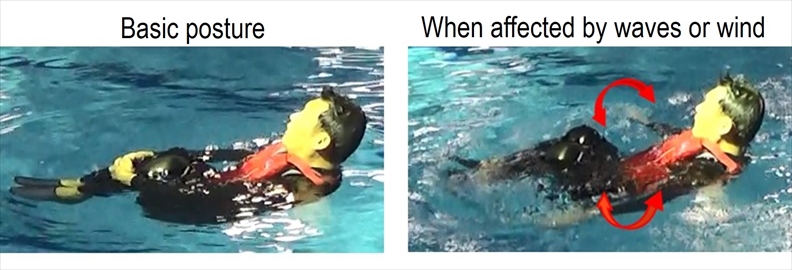
When Wearing a Lifejacket
[Click to play the video]
One technique is to float while hugging your knees to your chest, which helps reduce heat loss while wearing a lifejacket.
If waves or wind make it hard to maintain your posture, gently move your arms and legs to keep a stable floating position.
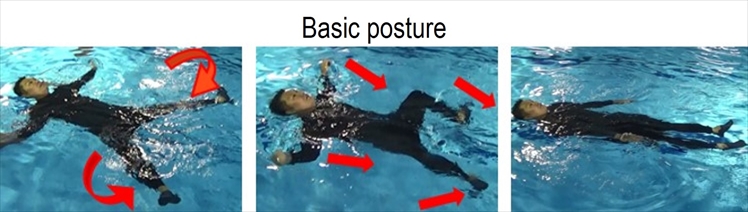
Floating on Your Back

[Click to play the video]
This technique involves moving your arms and legs in a way similar to elementary backstroke while floating on your back.
However, moving your limbs for a long time uses energy. As needed, make your movements smaller or slower to conserve strength.
When floating on your back, waves may splash over your face, making breathing difficult. It may also be hard to shout or wave for help, so be aware of these limitations.
Floating with Your Upper Body Raised
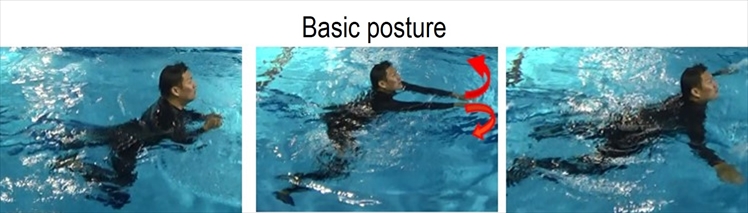

[Click to play the video]
In this technique, you keep your face above the water while gently moving your arms and legs in a breaststroke-like motion to stay afloat.
Again, moving continuously consumes energy. When necessary, stop moving, relax your body, and conserve strength.
※If you are uncomfortable putting your face in the water, slow your movements and focus on preserving your energy.
Conditions at the time of filming:
・Freshwater pool capable of creating waves and wind
・Clothing: rash guard, swimsuit, marine shoes
・Lifejacket buoyancy: approx. 6 kg
・Model: no competitive swimming experience (school swimming only)
Reference: In the Case of Rivers
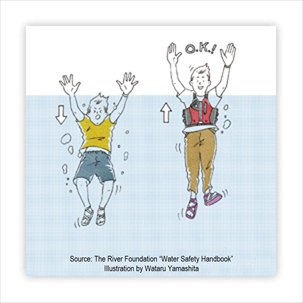 ●River water has lower salinity than seawater, so its density is lower and people float less easily. The environment is quite different from the sea.
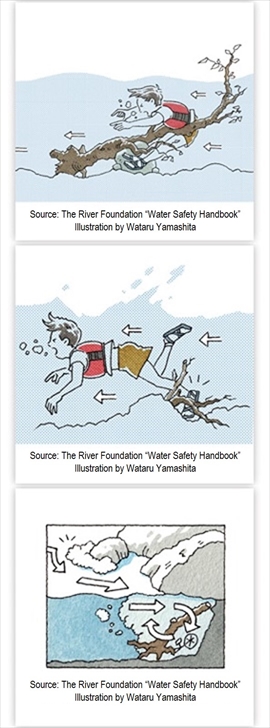 ●Wearing a lifejacket does not prevent 100% of water accidents. The strong forces in flowing water can sometimes exceed the lifejacket’s buoyancy, leading to dangerous situations where you may be trapped underwater.